Vendor Risk Assessment Workflow Explained
Companies don't fail to assess vendors — they assess them late, in silos, with no record. The five-phase workflow: risk tiering at intake, parallel security, privacy, compliance, financial, and operational reviews, and a decision record that survives the audit.
By Jason Ma. Published . Updated
Every vendor your company signs is a set of risks it just agreed to carry: their security posture, their privacy practices, their financial stability, their ability to actually deliver. Vendor risk assessment is how organizations evaluate those risks before the commitment is made — and increasingly, it's not optional. Regulators have made third-party risk a first-class obligation; for Canadian financial institutions, OSFI B-13 expects technology and cyber risk from third parties to be identified, assessed, and managed throughout the relationship, with evidence to show for it.
The problem is rarely that companies don't assess vendors. It's that the assessments happen late, in silos, with no coordination and no record. Security runs a questionnaire in one tool. Privacy reviews in another. Finance checks credit informally. Nobody can see the whole picture, the reviews start after commercial momentum makes "no" expensive, and a year later nobody can reproduce what was actually evaluated.
This article describes the practical workflow: how vendor risk assessment should be triggered, tiered, executed across functions, decided, and maintained over time.
The Shape of the Workflow
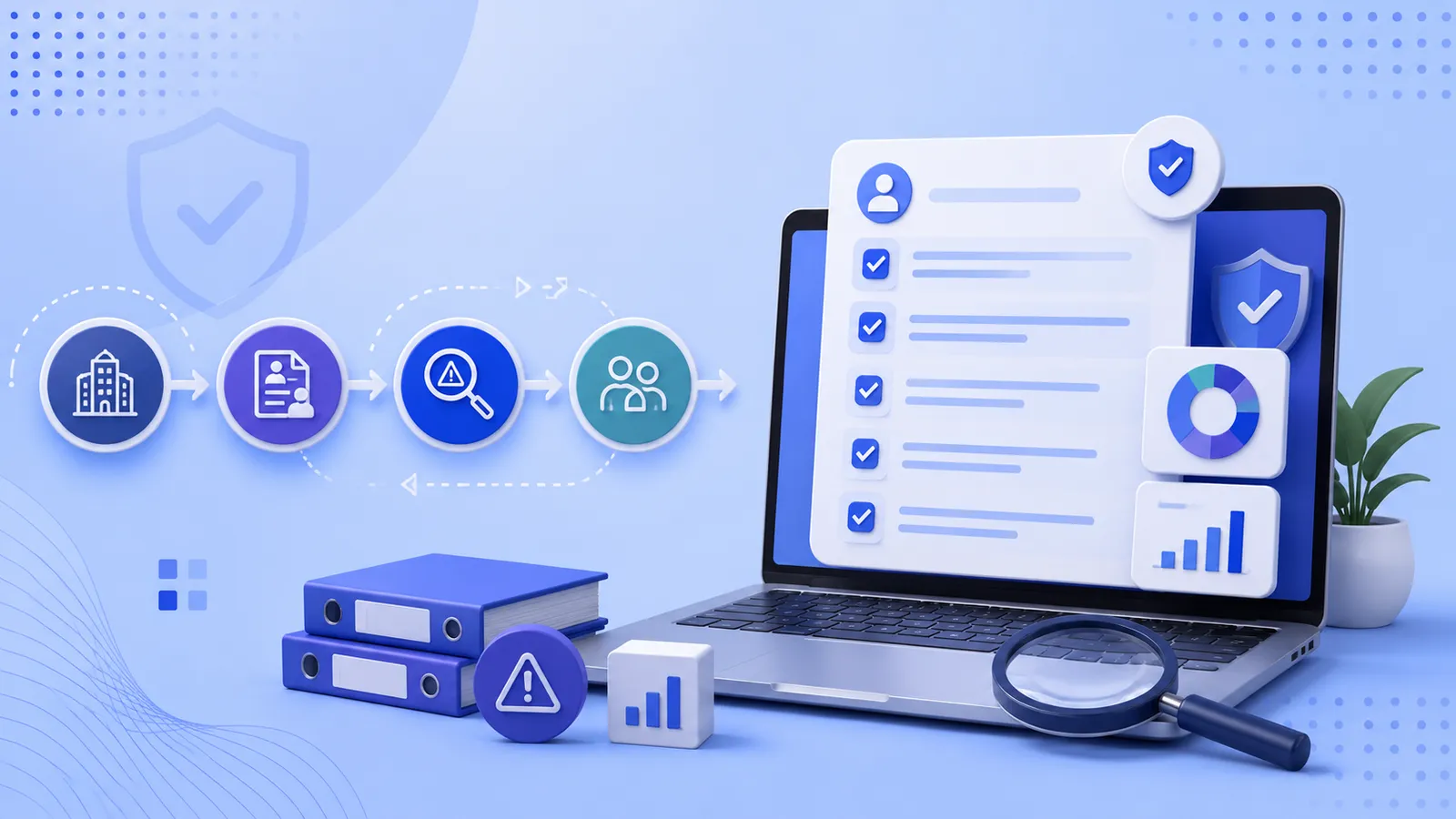
A working vendor risk assessment process has five phases:
Trigger and tier — the request arrives, and risk classification determines assessment depth
Parallel functional assessments — security, privacy, compliance, financial, and operational reviews run concurrently, each by its own owner
Decision — findings consolidate into an approve / approve-with-conditions / reject outcome
Record — the decision and its evidence are captured in one place, immutably
Ongoing reassessment — because the vendor you approved is not the vendor you'll have in eighteen months
Most organizations do phase 2 reasonably well in isolation. The failures concentrate in everything around it: late triggers, missing tiers, sequential reviews that should be parallel, and decisions that evaporate the moment the deal closes.
Phase 1: Trigger and Tier
The assessment should be triggered by intake — the moment a vendor request enters the pipeline, not the week before signature. A structured intake form gives the risk tiering everything it needs: what data the vendor touches, what systems it integrates with, deal value, jurisdiction, whether AI is in scope.
From those answers, classify the vendor into a tier. A common three-tier model:
Low risk. No sensitive data, no system integration, low spend. A SaaS tool for making diagrams. Assessment: certification check and standard terms. Hours, not weeks.
Moderate risk. Limited data access or meaningful spend. A tool that holds employee names and emails, or integrates with internal systems without touching customer data. Assessment: focused security questionnaire, privacy screen, standard financial check.
High risk. Customer PII, financial data, core-system integration, regulated processes, or material business dependence. Full assessment across every function, senior approval, contractual risk controls.
Tiering is what makes the workflow survivable. Run the full battery on every vendor and the process collapses under its own weight — reviewers burn out, the business routes around the process, and the high-risk vendors get the same diluted attention as the diagram tool. Proportionality isn't a shortcut; it's what keeps the deep reviews deep.
One tiering rule worth adopting now: any vendor with AI capabilities gets at least a moderate-tier look, regardless of spend. AI features change the data-handling questions — what's used for training, where outputs come from, what the model can leak — and most AI enters companies inside tools nobody labeled as AI. A $200/month "writing assistant" with access to your CRM is not a low-risk purchase.
Phase 2: The Functional Assessments
Each assessment belongs to the function that owns the expertise, performed in that function's own tools. The workflow's job is to launch them in parallel, give each reviewer the intake context, and collect what comes back. Sequential reviews — security waits for legal waits for finance — are how a three-week assessment becomes a three-month one.
Security assessment — owner: security team. Evaluates the vendor's controls against the access being granted: certifications (SOC 2 Type II, ISO 27001 — the report, not the badge on the website), authentication and encryption practices, incident history and breach-notification commitments, and subprocessor exposure. Depth scales with tier: a certification review for moderate, a full questionnaire and architecture conversation for high.
Privacy assessment — owner: privacy or legal. Triggered whenever personal information is in scope. Determines lawful basis, data residency and cross-border transfer implications, retention and deletion practices, and whether a DPA is required — which, under PIPEDA-class regimes, it is whenever PII flows. For high-tier vendors, this is where a formal privacy impact assessment gets commissioned. The workflow records that the assessment was required, who performed it, and what it concluded; the assessment itself is the privacy professional's work product.
Compliance assessment — owner: compliance or legal. Maps the vendor against regulatory obligations: sector rules, sanctions and jurisdiction screening, and — for regulated entities — whether the arrangement meets outsourcing expectations like B-13's. The output is a determination, with reasoning, that the relationship is permissible and what conditions apply.
Financial assessment — owner: finance or procurement. Answers one question: will this vendor exist and perform for the life of the commitment? Credit signals, funding stage for startups, customer concentration, and pricing-model risk. Financial review is routinely skipped for small vendors — and a critical-path tool from a startup that folds is an operational incident no security questionnaire would have caught.
Operational assessment — owner: the business and IT. Evaluates dependence and resilience: SLAs and support model, business continuity and disaster recovery, exit and data-portability terms, and concentration risk — how much of your operation runs through this one provider. The question isn't only "is this vendor safe?" but "what happens to us on the day they aren't available?"
Not every tier runs all five. The tiering decision in Phase 1 determines the set; the point is that the set is decided by rule, recorded, and visible — not assembled ad hoc per deal.
Phase 3: The Decision
Findings consolidate in front of a decision-maker with authority matched to the tier. Three honest outcomes:
Approve. Risks assessed, acceptable as-is.
Approve with conditions. The most common real-world outcome: proceed, contingent on a signed DPA, a remediation commitment, an added contract clause, or a compensating control.
Reject. Risks exceed appetite and can't be conditioned away.
There's a fourth outcome that happens constantly and gets recorded almost never: proceed over an objection. A reviewer recommends against; the business accepts the risk anyway. That is sometimes the right call — business leaders own business risk. But it must be a recorded call: the recommendation, the dismissal, the accepter's name, the date. An overridden security recommendation with a named executive owner is a governance decision. The same override, undocumented, is a finding with a lawsuit attached. If your workflow can't capture a recorded dismissal, it isn't capturing how decisions actually get made.
Phase 4: The Record
Everything above is worthless in an audit if it can't be reproduced. The decision record should hold, in one place: the intake context, the tier and its rationale, each functional assessment's outcome with its evidence artifact, conditions imposed, exceptions accepted and by whom, and the final approval. Locked once the decision is made — an audit trail that can be edited after the fact isn't an audit trail.
This is precisely what a B-13 examiner or a SOC 2 auditor asks for: not whether you have a vendor risk policy, but whether you can show it operating on this vendor, on that date, with these reviewers. Companies that scattered the evidence across five tools and four inboxes spend weeks reconstructing it. Companies with a unified record answer in minutes.
Phase 5: Reassessment
The assessment you ran at signing decays. Vendors get acquired, ship AI features, change subprocessors, suffer breaches, drift from the posture you approved. Mature programs treat the approval as the start of monitoring, not the end of scrutiny: high-tier vendors reassessed annually, moderate-tier on renewal, and event-driven reviews triggered by breaches, ownership changes, or material scope changes. The renewal moment is the cheapest trigger you'll ever get — the contract already forces a decision; attach the reassessment to it.
The Workflow Is the Control
None of the five assessments is novel; every function already knows how to do its own review. What organizations lack is the connective layer — the workflow that triggers reviews early, tiers them proportionally, runs them in parallel, forces a real decision, and leaves a record that outlives everyone's inbox. Build that layer once and it doesn't just serve vendor risk: it's the same front door, the same routing, and the same decision record that every other reviewed request in the company needs.
Related reading
- Vendor Due Diligence Checklist for Procurement and Risk Teams
- Vendor Risk Tiering: How to Segment Suppliers by Risk and Apply the Right Controls
- How AI Agents Run Continuous Supplier Risk Monitoring
- Supplier Lifecycle Management Stages and What Happens at Each One
- Contract Renewal Management Process and Who Should Own It
Source: NIST Cybersecurity Framework