Procurement Intake Process: Steps, Owners, and Approvals
Most procurement delays start before sourcing ever begins — with incomplete, poorly routed requests. A step-by-step breakdown of the intake process: who owns each stage, what approvals apply, and why the decision record matters as much as the decision.
By Jason Ma. Published . Updated
Most procurement delays do not start with sourcing, negotiation, or supplier onboarding. They start earlier — with a request that was incomplete, unclear, or sent to the wrong person.
In most organizations, purchasing requests arrive through email, spreadsheets, chat, or hallway conversations. Procurement then spends days chasing missing information, identifying approvers, and coordinating reviews across security, legal, finance, and IT. The purchase is delayed, the requestor is frustrated, and — the part that hurts most later — nobody can reconstruct who approved what, when, or why.
A structured intake process fixes this. But here is the framing that matters: intake is not a form. It is the decision and record layer that sits in front of every purchase. The review work still happens where it always has — legal in legal's tools, security in security's tools. Intake's job is to capture the request completely, route it to the right reviewers at the right time, collect their decisions, and produce a defensible record.
This article walks through the end-to-end process, who owns each stage, what approvals are required, where it breaks down, and how organizations standardize it.
What Is Procurement Intake?
Procurement intake is the formal process through which employees submit requests for goods, services, software, consultants, or vendors that require procurement involvement.
It is the front door to purchasing. Before anyone negotiates pricing, runs an RFP, or onboards a supplier, someone has to communicate a business need. Intake captures that need in a structured format and routes it through the right reviews.
The goals are consistent across organizations:
Capture complete request information upfront
Identify required reviewers automatically
Route requests to the right stakeholders in the right order
Ensure policy compliance before commitments are made
Produce an auditable record of every decision
Reduce cycle time by eliminating back-and-forth
That last point deserves emphasis. For regulated companies — Canadian financial institutions subject to OSFI B-13, anyone handling personal information under PIPEDA — the intake record is not administrative exhaust. It is the evidence that third-party risk was assessed before the relationship began. When an auditor asks "show me how this vendor was approved," the intake record is the answer. Or it isn't, and that's a finding.
The End-to-End Procurement Intake Process
Every organization tunes the details, but the structure is remarkably consistent.
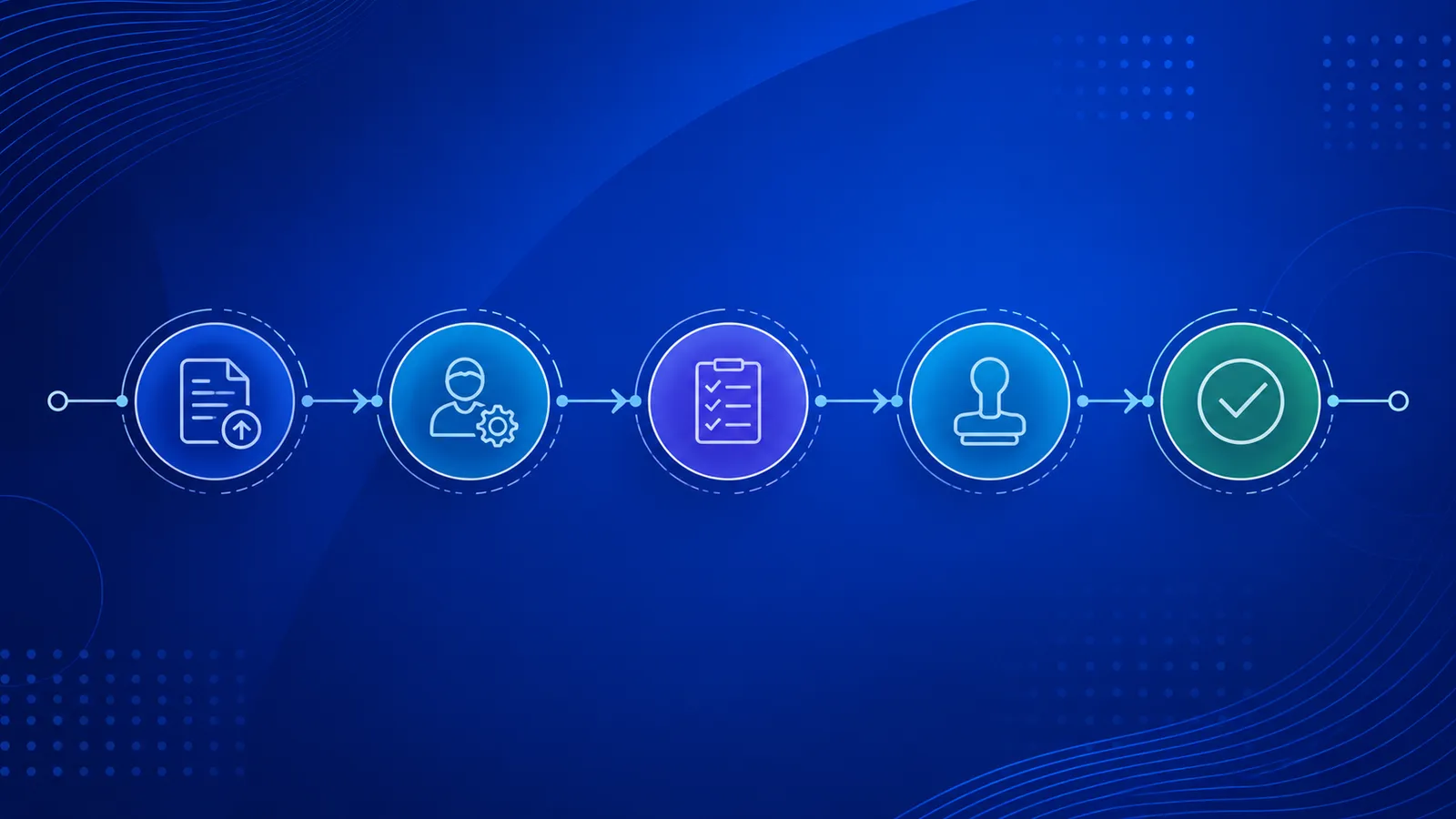
Step 1: Business Need Identification
Owner: Requestor
The process begins when an employee or department identifies a need: new software, a consulting engagement, a contract renewal, equipment, professional services.
The requestor should be able to articulate what is being purchased, why, the expected outcome, the timeline, and the estimated budget. The single most common source of downstream delay is a request without a clear business justification. If the requestor can't explain the purpose, every reviewer who touches the request will stop and ask.
Step 2: Intake Submission
Owner: Requestor
The requestor submits through an approved intake channel. Well-designed intake forms collect: request title, department, cost center, budget owner, purchase category, estimated spend, supplier name if known, business justification, requested timeline, and supporting documents.
The objective is to eliminate back-and-forth later. Every missing field today becomes an email tomorrow.
The best intake systems go beyond static forms: they adapt questions to the request. A $400 software subscription and a $200K data-processing vendor should not face the same form — and intake should detect when a "software purchase" is actually an AI tool handling customer data, because that answer changes everything downstream.
Step 3: Budget Validation
Owner: Budget Owner or Department Manager
Before anyone invests review time, the organization validates funding. Is budget available? Is this planned or unplanned spend? Which cost center is charged? Does it align with departmental priorities?
If funding is unavailable, the request is rejected, deferred, or escalated — and that outcome should be recorded, not lost in an email thread. Budget validation is typically the first formal checkpoint.
Step 4: Manager Approval
Owner: Department Manager
The manager confirms the request is legitimate, supports business objectives, is appropriately timed, and that internal alternatives were considered. This gate keeps low-priority requests from consuming procurement's attention. Without it, procurement teams drown.
Step 5: Procurement Review
Owner: Procurement
Procurement assesses the requirements, determines sourcing strategy, reviews supplier information, evaluates whether competitive bidding is required, and flags policy exceptions. The outcome might be: proceed with an existing supplier, request quotes, run an RFP, consolidate with an existing contract, or reject the request as non-compliant.
Step 6: Cross-Functional Reviews
Owners: Security, Legal, Finance, IT, Privacy
This is where most intake processes either work or collapse. Depending on the purchase, additional reviews kick in:
Security assesses data handling, security controls, certifications, and third-party risk exposure.
Legal evaluates contract terms, liability, data protection obligations, and IP clauses.
Finance validates budget impact, payment structure, and accounting treatment.
IT assesses compatibility, integration requirements, and infrastructure impact.
Privacy determines whether a privacy assessment is required when personal information is involved.
Two design principles separate mature intake from broken intake here.
First: not every request needs every reviewer. The required reviews should be determined automatically from request type, spend, category, and risk profile — not by a requestor guessing or a coordinator manually tagging people.
Second: each function reviews in its own tools, but every decision lands in one record. Legal doesn't need a new contract tool; security doesn't need a new risk platform. What the organization needs is one place where each function's decision — approve, approve with conditions, reject, or a recorded waiver — is captured with its evidence. A security exception consciously accepted and documented is a governance decision. The same exception, undocumented, is a finding waiting for an audit.
Step 7: Final Approval
Owner: Authorized Approver
After reviews complete, the request moves to final approval, usually tiered by spend:
Spend Range Typical Approver Under $5,000 Department Manager $5,000 – $25,000 Director $25,000 – $100,000 Vice President Above $100,000 Executive Leadership
The thresholds vary; the principle doesn't. Spending decisions get reviewed at the level appropriate to their size and risk — and the approval is recorded against the request, immutably, so the chain of accountability survives staff turnover and tool migrations.
Step 8: Handoff to Execution
Owner: Procurement
This is where intake ends. With the decision made and recorded, the request hands off to execution: negotiating pricing, issuing purchase orders, finalizing contracts, onboarding the supplier — sourcing and contracting activities, run in the systems built for them.
The boundary matters. Intake's job is to get a request from submission to a complete, defensible decision. The record should capture the handoff — what was approved, by whom, and where execution picked it up — so the trail is unbroken.
Common Procurement Intake Bottlenecks
The same failures recur everywhere:
Incomplete requests. Missing justifications, unknown suppliers, undefined budgets. Procurement spends days collecting what a structured form captures in minutes.
Approval confusion. Employees don't know who approves, when, or in what order. Every request becomes an investigation.
Email-based workflows. Information gets lost, stakeholders get missed, status visibility disappears, and the audit trail is a folder of forwarded threads nobody can reconstruct eighteen months later.
Late risk reviews. Security, legal, and privacy are engaged after commercial momentum has built. The review becomes a blocker instead of a gate — and the pressure to skip it grows.
No visibility. "Who has my request? What's blocking it?" When requestors can't see status, procurement becomes a help desk for status inquiries instead of a function that moves requests forward.
How Organizations Standardize Intake
High-performing organizations converge on the same practices:
Standard request forms that collect required information before the request enters the workflow.
Automated routing that directs requests to managers, budget owners, procurement, and risk reviewers based on rules, not manual coordination.
Approval policies defined by spend, category, department, and risk level, so reviews are predictable and repeatable.
Centralized visibility so every stakeholder sees status, current owner, and pending approvals.
Governance embedded in the workflow. Employees shouldn't need to remember policy. The process should enforce it: the right reviews triggered automatically, exceptions recorded rather than silently waived, every decision written into an immutable record before anything is committed.
Why Intake Is Bigger Than Procurement
Here is the uncomfortable truth most procurement content skips: the intake problem is not a procurement problem. The same broken pattern — unstructured requests, unclear approvers, late reviews, no record — exists for access requests hitting IT, contract reviews hitting legal, vendor questionnaires hitting security, and onboarding requests hitting HR.
Organizations that solve intake only for procurement end up with five front doors, five routing systems, and five incompatible audit trails. The ones getting ahead of this treat intake as a single enterprise capability: one front door, consistent routing, one decision record format — regardless of which function does the reviewing.
Procurement is where the pain is most visible, and often where the fix starts. But the destination is bigger: every request entering through one structured front door, reaching the right reviewers early, and leaving behind a record that stands up to any auditor.
Get intake right and approvals move faster, reviews happen earlier, and the question "who approved this, and why?" always has an answer.
Related reading
Source: NIST Cybersecurity Framework