What Belongs on a Vendor Intake Form (With Examples)
Every field missing at submission becomes an email later. The complete breakdown of what a vendor intake form should capture — supplier details, budget, data and security requirements, legal terms, and the exceptions section almost everyone omits — with examples of good answers.
By Jason Ma. Published . Updated
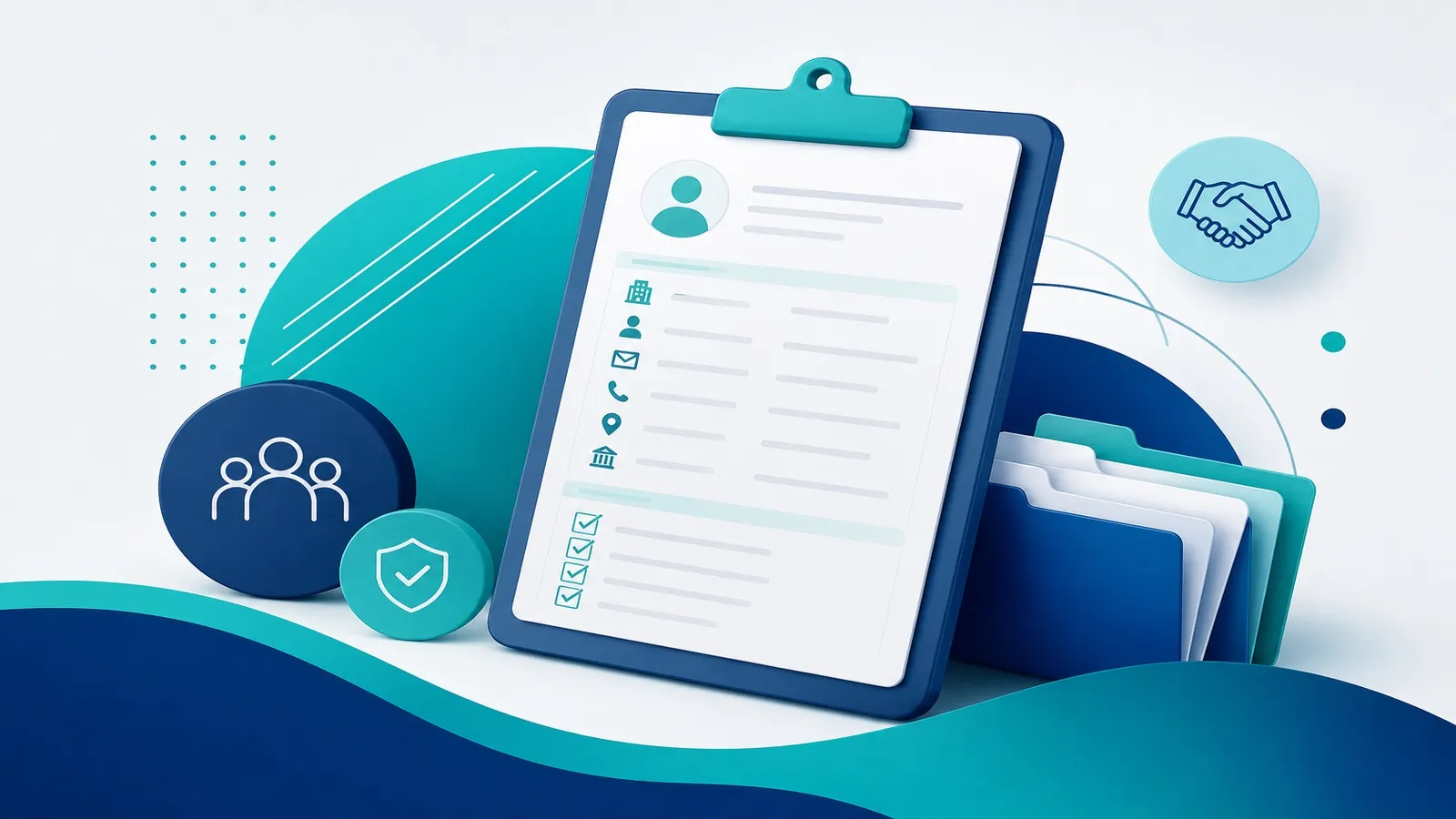
A vendor intake form has one job: capture everything reviewers need to make a decision, before the request enters the workflow. Every field missing at submission becomes an email later. Every email later adds days to the cycle.
But there's a second job most forms ignore. The intake form is the first entry in the record of how this vendor relationship was approved. When an auditor asks, eighteen months from now, "what did you know about this vendor when you approved them?" — the intake form is the answer. Design it as evidence, not as paperwork.
This article breaks down the fields a vendor intake form should contain, why each one exists, and examples of what good answers look like. It also covers the design mistake that kills most forms: asking every requestor every question.
The Design Principle: Adaptive, Not Exhaustive
Before the fields, one rule.
A form that asks 60 questions of someone buying a $300 design tool will be abandoned, worked around, or filled with garbage. A form that asks 8 questions of someone engaging a vendor to process customer financial data will pass an incomplete request into the workflow.
Good intake forms branch. A handful of triage questions up front — what are you buying, roughly how much, will it touch company or customer data — determine which sections appear. The requestor sees only what's relevant to their request. The reviewers get everything they need for that risk profile.
With that established, here are the sections.
1. Request Basics
The minimum to identify and route the request.
Request title — short and specific. "Figma licenses for design team," not "software."
Requestor name and department — usually auto-filled from SSO.
Date needed — a real date, not "ASAP." Timelines drive prioritization and expose requests submitted too late for proper review.
Request type — new vendor, renewal, scope expansion, or one-time purchase. Renewals and new vendors follow different review paths.
Example: "Renewal — Datadog observability platform, Engineering, needed by contract expiry March 31."
2. Business Justification
The most commonly skipped section and the most expensive to skip. Every reviewer downstream reads this first.
What problem does this solve? Two or three sentences. A purchase nobody can justify is a purchase nobody should approve.
What happens if we don't buy it? Forces the requestor to articulate the cost of inaction.
Alternatives considered — including existing tools. A surprising share of requests duplicate something the company already pays for.
Expected outcome — what changes if this succeeds, and how would you know.
Example: "Support team handles 400 tickets/week in shared inboxes. Response times average 14 hours; target is 4. We evaluated extending Jira Service Management (clunky for external customers) and building internal tooling (6+ months of eng time). Zendesk closes the gap in weeks."
Weak justifications don't just slow approval — they produce decisions that can't be defended later. "Why did we approve this vendor?" should never be answered with a shrug.
3. Supplier Details
What the organization needs to know about who it's dealing with.
Supplier legal name and website
Headquarters and operating jurisdictions — matters for data residency and regulatory exposure. A Canadian financial institution under OSFI B-13 needs to know where its third parties operate, not just where they're incorporated.
Existing relationship? — current vendor, past vendor, or net new. Net-new vendors trigger fuller diligence.
Primary contact at the supplier.
Subcontractors or fourth parties — does the supplier rely on other providers to deliver the service? Fourth-party risk is increasingly a regulatory expectation, not a nice-to-have.
Example: "Acme Analytics Inc., Delaware C-corp, data processed in AWS us-east-1 and eu-west-1. Net-new vendor. Relies on OpenAI API for summarization features."
That last sentence is the kind of detail that changes a review entirely — and the kind a generic form never surfaces.
4. Budget and Financial Information
Finance can't validate what isn't stated.
Estimated total cost — first-year and full contract term. A "$10K tool" with a three-year auto-renewing term is a $30K+ commitment.
Cost center and budget owner — who pays, and who has authority over that budget.
Budgeted or unbudgeted — unplanned spend follows a different approval path in most organizations.
Pricing structure — subscription, usage-based, one-time, or professional services. Usage-based pricing deserves a flag of its own; it's where budget surprises live.
Payment terms if known — annual upfront vs. monthly affects cash planning.
Example: "Estimated $48K/year, 2-year term, usage-based overage on API calls. Marketing cost center, budget owner J. Chen. Budgeted in FY26 plan."
5. Data and Security Requirements
These fields determine whether a security review is required and how deep it goes. They should appear automatically whenever triage indicates the vendor touches systems or data.
What data will the vendor access, store, or process? Categories, not essays: customer PII, employee data, financial records, source code, none.
Volume and sensitivity — a vendor seeing 100 internal email addresses and a vendor processing your full customer transaction history are different conversations.
Integration points — will it connect to your SSO, your CRM, your data warehouse? Each integration is an access grant.
Compliance certifications held — SOC 2 Type II, ISO 27001, PCI DSS where relevant. Ask for the report, not just the claim.
Is this an AI tool, or does it embed AI features? This question belongs on every modern intake form. AI features mean training-data questions, output-reliability questions, and — for regulated entities — model-risk questions. Most shadow AI enters companies through purchases nobody flagged as AI.
Example: "Tool will process customer support transcripts (PII: names, emails, account numbers). ~50K tickets/year. Integrates via Zendesk API and Okta SSO. SOC 2 Type II report available. Embeds LLM-based summarization; vendor states no training on customer data — contract clause needed to bind that claim."
6. Legal and Contractual Considerations
Legal reviews the contract; the form captures what legal needs to scope that review.
Contract type and term — MSA, order form, click-through. Click-through terms deserve scrutiny precisely because nobody reads them.
Auto-renewal? — and the notice window to cancel. Missed cancellation windows are among the most common sources of wasted spend.
Will the vendor sign a DPA? — required wherever personal information flows, and non-negotiable under PIPEDA-class regimes.
Liability and indemnification expectations — flag if the vendor's paper caps liability at trivial amounts while handling significant data.
IP considerations — who owns outputs, configurations, or anything built on the platform.
Example: "Vendor MSA with order form, 24-month term, auto-renews with 60-day notice. DPA offered. Liability capped at 12 months' fees — flag for legal given PII scope."
7. Review Acknowledgments and Exceptions
The section almost every form omits, and the one that matters most to the record.
Requested exceptions — is the requestor asking to skip or expedite any standard review? Stated openly, an exception is a decision leadership can make. Discovered later, it's a finding.
Known risks the requestor wants to disclose — surfacing a concern at intake is cheap; surfacing it post-signature is not.
Attestation — the requestor confirms the information is accurate to their knowledge. It sets the tone: this form is a record, and records are owned.
If a reviewer later waives a requirement — security accepts a missing certification, legal accepts a liability cap — that waiver should be recorded against the request with a reason and a name attached. A consciously accepted risk is governance. A silently skipped review is exposure.
What to Leave Off
Restraint is part of design. Leave off anything the requestor can't reasonably know (security architecture details — that's the security review's job, in security's tools), anything your systems already know (org structure, manager, cost-center mappings), and anything collected "just in case." Every unnecessary field trains requestors to treat the form as bureaucracy — and bureaucracy gets routed around. The form's credibility is a security control in itself: the moment people start going around it, your front door has a side entrance.
The Form Is the First Page of the Record
A vendor intake form isn't a gate for its own sake. It's the structured capture that lets routing happen automatically, lets reviewers start with complete information, and produces — at the end — a decision record that explains what the organization knew, who reviewed it, what they decided, and what exceptions were consciously made.
Get the form right and everything downstream accelerates: fewer clarification emails, earlier risk reviews, faster approvals. And when someone asks "how was this vendor approved?" — the answer is already written.
Related reading
Source: NIST Cybersecurity Framework